
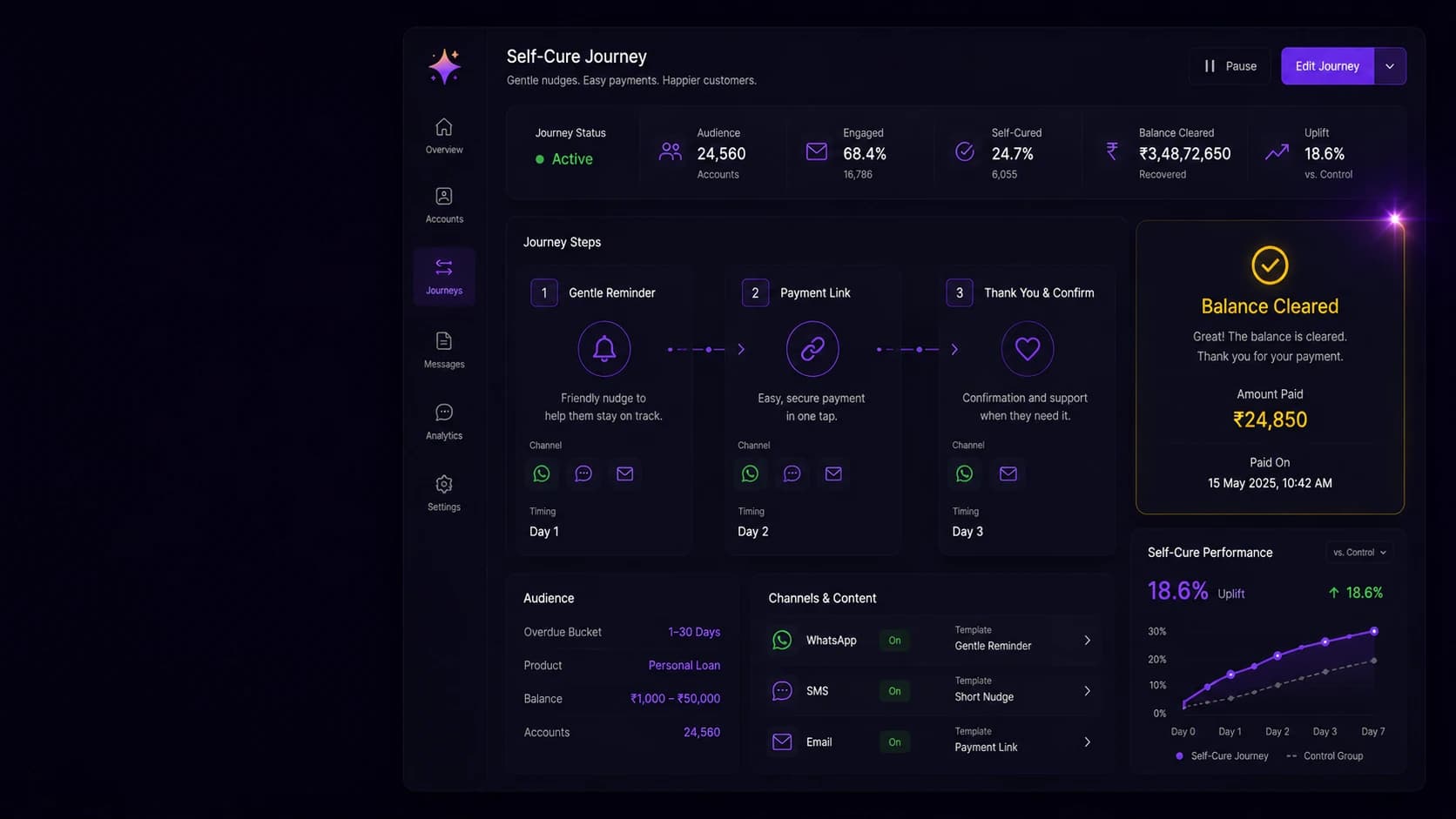
Turn reminders into repayments.
Behaviour-driven nudges that reach the right borrower, on the right channel, at the right moment, so more of them self-cure before an agent ever has to call.

Overview
Most overdue borrowers want to pay, they just need the right nudge.
Treating every missed instalment the same way wastes money and annoys good customers. Collection Marketing AI reads repayment behaviour and intent, then crafts a message (tone, offer, channel and timing) tuned to each individual. The result is a quiet, respectful nudge that gets paid, not an aggressive dunning call.
By moving recovery upstream into self-cure, you keep expensive human agents and legal action for the small minority who truly need them, while everyone else clears their balance from the comfort of their own phone.
More self-cure
borrowers repay on their own before manual collections kick in.
Fewer DPD roll-forwards
accounts cure early instead of sliding into deeper delinquency buckets.
Lower collection cost
automated nudges cost a fraction of agent calls and field visits.
A marketing engine pointed at recovery.
Segmentation, personalisation and measurement: the full performance-marketing toolkit, purpose-built for collections.
How it works
- 01
Understand
Read repayment behaviour, intent and channel response to segment overdue accounts by likelihood to cure.
- 02
Personalise
Choose the next-best action, then tailor tone, offer, channel and send-time to each borrower.
- 03
Nudge
Deliver the message with a payment link or plan option, and run multi-step self-cure journeys automatically.
- 04
Convert
Measure uplift against holdouts, learn what works, and re-target only the accounts that still need a human touch.
Outcomes
More Self-cure Rate
borrowers clear balances on their own, before manual collections begin.
Fewer DPD roll-forwards
accounts cure early instead of sliding into deeper delinquency.
Lower Cost to collect
automated nudges replace a large share of agent calls and field visits.
See the uplift
Run a self-cure pilot on your book.
We’ll set up a behaviour-driven journey against a holdout group and measure the incremental recovery, so the uplift is proven, not assumed.